
Types of Coffee
Now that you understand the various methods of brewing coffee, you can create a wide variety of coffee drinks ranging from cappuccinos and lattes to breves and mochas. Depending on the ratio of espresso, coffee, milk, flavoring syrups, and other ingredients, there is no end to the combination of drink varieties that baristas can tailor to their customers’ tastes. Some of the more notable and most popular types of coffee drinks include:
To pull a perfect espresso shot each and every time, follow these general guidelines:
Equipment:
- Espresso Machine
- Grinder
- Scale
- Portafilter
- Tamper
- Filtered Water (bad quality water can affect the taste of your espresso and even damage espresso machine)
- Cup
- Quality Coffee
- Timer
Extraction: Before you begin, be sure to pre-heat youre spresso machine, portafilter and cup by pulling a ‘blank’ shot, which means running water through the portafilter and cup without using espresso.
- Grinding:Always grind fresh whole beans right before brewing [this goes for any and every brew method]. The grind texture is an important aspect of shot quality. Too fine a grind will cause a slow, over-extracted shot that can taste bitter and burnt. Too coarse a grind will result in an under-extracted shot that is weak, watery and tastes sour.The ideal grind texture you are looking for is something similar to that of granulated sugar, but to know for sure, you will need to test out your grinder and machine [as well as base it off your own personal preference as a baritsta
- Dosage:refers to the amount of coffee you will need to fill the portafilter to make your espresso shot. The dose for a “double-shot” [the most common way espresso is made] should be between 20-24 grams [this also depends on your espresso machine
- Tamping:ensures uniformity of extraction by leveling and packing the grounds to ensure equal and consistent water contact is forced through the coffee. The proper tamp method is to hold your elbow at 90 degrees, rest your portafilter on a level surface and then apply pressure until the coffee has an even, polished look. Note: coarser grounds will require a firmer tamp than finer grounds.
- Brewing/Extract:Place the portafilter into your machine’s brew head and place your preheated cup beneath it. Grab a timer and time your shot – this is critical to learning how to pull a perfect shot. Initiate the pull and watch carefully.
- Results:If the dose, grind and tamp are ideal, the first part of the brew should be be dark before it turns to a golden brown/foamy mixture that flows into the cup in a thin stream [without breaking]. The volume of water for each shot should be 1 oz. – so after your double shot has reached 2 oz., stop the shot and check your timer. The ideal brewing time you’re looking for is between 25 – 35 seconds – if you’re running too long or too short, check your grind, dose and tamp, then adjust it accordingly. If your shots are coming out unevenly from both spouts, your tamp needs to be more even.
* All machines and BARISTAS are different, so practice and experiment. Following general guidelines will help ensure espresso shot(s) are pulled properly, but playin
Milk Steaming
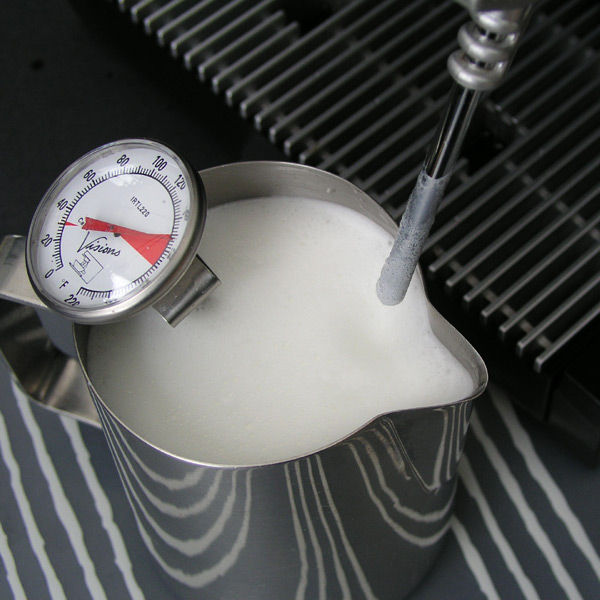
Steaming milk may seem simple, but it’s remarkably difficult to do well. The key is to remember that there are two phases to steaming: aerating, ( stretching ) and emulsifying (texturing). You need both to have a creamy,Silky, Smooth, velvety batch of milk with enough body to create latte art .To aerate, place the steam wand’s valve into the milk and turn on the wand. The whirlpool of milk will capture air at the surface and incorporate it into the milk. Once you’ve mixed in some air, plunge the steam wand deeper into the milk to further stir and emulsify it.
Pour milk in your pitcher (Fill your pitcher roughly half full of cold milk.)
Purge the steam wand(Crank up your steam wand and let it run for a couple of seconds to purge any leftover gunk trapped in the tip and allow the wand to heat up a little.
Get ready (Set the wand into the milk so that the line at which the tip screws in is level with the surface of the milk. The wand should be at about a 15-degree angle from the side of the espresso machine and slightly off center in the pitcher, with the handle of the pitcher running parallel to the wand).
Stretch and texture the milk... Stretching the milk is introducing air to create foam. You can determine whether you are creating foam by listening for popping sounds and watching for the milk volume to increase
Turn off the steam valve (After the milk reaches the preferred temperature—determined either with a thermometer or a trained hand—turn off the steam valve.
The reason we steam milk in metal pitchers is so that we can feel the temperature as the milk heats up. Hold the pitcher from the bottom, and emulsify the milk until the temperature is just barely too hot for your hand. At that moment, turn off the steam valve and remove the pitcher.
Remove the pitcher; wipe the steam wand immediately (Lower the pitcher and immediately wipe the steam wand with a clean, dry towel. If you leave milk on the wand, it will quickly harden and can become difficult to remove
Tap out the air bubbles; give it a swirl( You can further groom the texture of the milk by tapping the pitcher on the counter and giving it a spin.don’t panic if the milk sits on the counter while you’re pouring the shot—it will take a couple minutes for the foam to separate, so you have time.
Pouring
Begin with the cup tilted slightly away from you(This will allow you to create a latte pattern with minimal movement of your pitcher hand)
Pour steamed milk into the center of the cup (Holding the pitcher about an inch above the cup, pour the milk into the center of the crema. Pour steadily and slowly.)
Drop the pitcher closer to the cup; speed up your pour (Gently move the pitcher closer to the cup and tip it with your thumb to slightly speed up the pour.)
Toggle the pitcher gently and fluidly back and forth to begin creating a zigzag pattern.
Untilt the cup, slow down, raise the pitcher a half an inch, and finish the rosetta(Back the pitcher toward the edge of the cup closest to you while untilting the cup. Slow down your pour slightly, raise the pitcher about a half an inch above the flat cup, and drizzle a small stream of milk back across the center of the cup to finish the pattern )
Speciality Coffee Drinks

- Black Coffee: Coffee served with no cream or sugar
- Espresso, Ristretto & Lungo: Contains no milk. A strong concentration of black coffee made in an espresso machine by forcing water through coffee beans under 9 bar pressure. Espresso is the foundation for many coffee drinks.
- Black Eye: Coffee with a shot of espresso.
- Americano: A single or double shot of espresso added to a cup of hot water.
- Breve: A latte prepared with half and half instead of whole milk.
- Cafe Mocha: One part espresso, one part chocolate syrup or powder and two thirds steamed milk.
- Cappuccino: 3 equal parts espresso, steamed milk, and foamed milk.
- Cafe Latte: One part espresso with three parts steamed milk with froth on top.
- Chai Latte: Chai tea mixed with a single shot of espresso.
- Cafe au Lait: Single shot of brewed coffee or espresso mixed in a 1:1 ratio with steamed milk.
- Cortado: Equal parts espresso and steamed milk.
- Frappe: A cold espresso drink blended with sugar, milk, and other flavorings into a thick drink, similar to a milkshake.
- Iced Coffee: Brewed coffee served over ice with sugar and milk.
- Irish Coffee: Coffee spiked with whiskey and cream added on top.
- Macchiato: Espresso with a dollop of steamed milk added in a 4:1 ratio.
How to Clean an Espresso Machine
Scrub, Rinse, Wipe
Run a clean cloth under hot water and wipe off your steam wands, cleaning off any milk that’s been scorched on the want. Be careful not to scrape the wand with anything sharp, as it’s made of stainless steel and can become scratched.
Use coffee detergent and scrubbing pads for cleaning down the group heads. If detergent sure to prevent this from happening.
Detergent(s)
Soak all grouphead parts, including filters, baskets, shower screens and steam wands. The tip of the steam wands should unscrew. Soak all parts in a solution of coffee detergent and hot water.In regards to your steam wands, it’s crucial that you purge them of any leftover milk and water after every cup. If milk drains back into the boiler, it can remain there forever.
Backflush
This only applies if you have an espresso machine with three-way valves. If so, you should backflush the machine at least once a day with clean water, and backflush using coffee detergent at least once a week. This process helps loosen and destroy any contaminants within the machine’s water lines and brewing valves.
Descaling commercial Espresso Machine
If you use properly filtered watered for your machine, a full descaling of your commercial espresso maker should be done once every three to six months. It’s essential to use filtered water for your espresso.
Water that is harder than 50 parts per million (ppm) will allow for the mineral buildup of calcium and magnesium deposits (limescale) on all the interior components of the machine. Eventually, this will lead to unnecessary repair costs or expensive and premature replacement costs.
Repeat
Make sure you maintain your equipment on a regular basis. Not only will customers enjoy the great taste they’ve come to love from your establishment, but you’ll enjoy the absence of equipment repair and replacement costs.
Advantage(s)
Splatters and other grime residue on your equipment may turn customers and patrons away.
The accumulation of coffee resins from oil on shower screens and group heads will alter the flavor and quality of your espresso beverages, making for a bitter taste. The oil in your coffee can turn rancid in as little in less than an hour
Mineral scales will accumulate on the internal parts of your commercial espresso machine without the regular cleaning. This is another reason you may also want to consider investing in a water softener.